
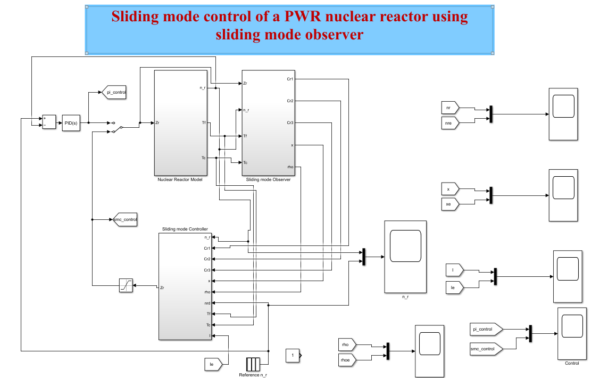
Sliding mode control (SMC) of a Pressurized Water Reactor (PWR) using a Sliding Mode Observer (SMO)
provides robust control, estimating unmeasurable states like xenon concentration and neutron precursor density using only output power data. The SMO enhances reliability by ignoring parametric uncertainties and external disturbances, while the SMC ensures precise power tracking and stability, often validated via Lyapunov approaches in MATLAB/Simulink.
Key Aspects of SMC with SMO for PWRs:
- Observer Functionality: Because xenon concentration, precursor densities, and reactivity cannot be directly measured in real-time, an SMO estimates these states. This observer is designed based on available measurements such as neutron flux or reactor power.
- Robustness: The sliding mode approach is inherently insensitive to external disturbances and parameter variations (such as temperature, burnup).
- Control Mechanism: The controller, often using a super-twisting algorithm to minimize chattering, regulates control rod movement to maintain desired power levels.
- Stability: The system’s stability is guaranteed by the Lyapunov stability theory, ensuring that the control system operates effectively across a wide range of operating conditions.
- Applications: This technique is primarily applied for load-following, where the reactor power must adapt to changing electrical demand, and for managing reactivity during xenon oscillations.
Reference Paper:
Ansarifar, G. R., and H. R. Akhavan. “Sliding mode control design for a PWR nuclear reactor using sliding mode observer during load following operation.” Annals of Nuclear Energy 75 (2015): 611-619.


Reviews
There are no reviews yet.